Help with energy bills and home upgrades in Pittsburg, Antioch, and East Contra Costa
WHERE THINGS STAND: The Healthy Homes Hub is open. We can connect you with energy bill discounts, free home upgrade programs, and clean energy training available now. We’re still seeking funding for our own installation program for free heat pump water heaters, induction cooktops, solar and repairs.
(Updated September 2026)
Pittsburg and Antioch carry a compounding set of burdens. Roughly 31% of residents live in communities designated as disadvantaged under CalEnviroScreen 4.0. Pittsburg ranks in the 97.4 percentile statewide for asthma rates. Proximity to Highway 4 and heavy industry drives outdoor air pollution that compounds indoor exposure from gas appliances, and about 83% of area households still heat water with gas.
The households most affected are the least able to act. Energy burden — the share of household income spent on home energy — is generally considered affordable below 3%. The typical household in Pittsburg or Antioch pays around 2%. But residents earning at or below 30% of Area Median Income pay roughly 9% in Pittsburg and 11% in Antioch.
And a significant share of low-income homes are turned away from existing weatherization and electrification programs entirely, deferred for mold, roof damage, failing plumbing, or panels too small to carry a new appliance.
Nationally, about 19% of homes referred to the Weatherization Assistance Program are deferred for health and safety conditions. No program in East Contra Costa currently exists to fix that — and closing that gap is what the Hub’s upgrade program is designed to do.
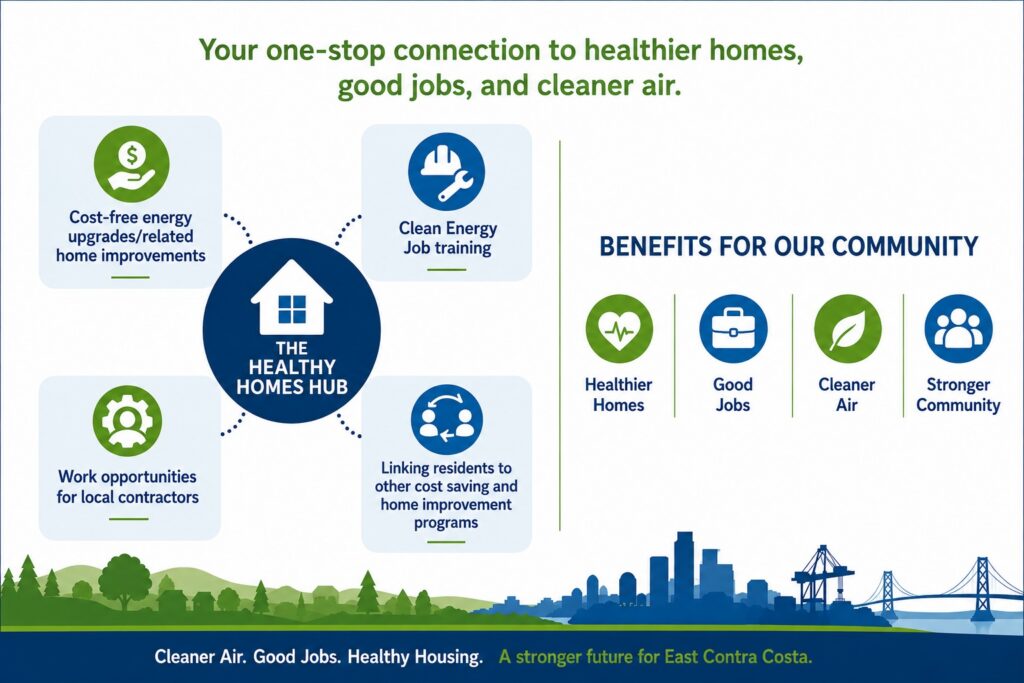
The Healthy Homes Hub is a place-based program led by community organizations rather than administered to the community from outside. It is designed around five integrated components:
Three of those components are running today. The Hub connects residents to existing utility, incentive and bill assistance programs, delivers education on indoor air quality and healthy homes, and is building the local contractor pool and workforce pathways the program will depend on. The direct installation and remediation work is designed and awaiting funding.
The Hub’s distinguishing feature is continuity. A single trusted advisor carries each household from first contact through assessment, scope, installation, and follow-up, the role residents told us during planning they most wanted, and the answer to the time, language, and trust barriers that stall otherwise motivated participants.
The model draws on San Francisco Environment’s Climate Equity Hub, adapted for East Contra Costa conditions. Solar and battery storage will be delivered through GRID Alternatives, a Collaborative member with established installation capacity in the region. GRID also administers DAC-SASH statewide on behalf of the California Public Utilities Commission, bringing rooftop solar to income-qualified homeowners in California’s most environmentally burdened communities — which means the Hub’s solar component is built on a funding stream and a delivery partner that are already in place.
The organizations behind the Hub are already embedded in the communities it serves, working with families, children, seniors, and job seekers across Pittsburg and Antioch. That is the asset. During planning, residents told us plainly that trust determines participation, and that unfamiliar assessors and contractors are a barrier rather than a service.
The Hub routes every outreach channel into a single intake point, so a resident’s experience is one program rather than many organizations.
With support from a California Jobs First Catalyst grant, the Collaborative completed a full implementation blueprint informed through robust community engagement:
Eighteen small, local and frontline contractors informed the workforce and contracting framework, and more than twenty-five subject matter experts from utilities, program administrators, labor, local government and workforce organizations were consulted during design.
Three program concepts were designed and approved by the Steering Committee, allowing the Hub to move on whichever funding materializes rather than waiting for a single source.
The Hub is operating. What we need funding for is the upgrade program at its center.
We are seeking bridge support to sustain coordination and early community and contractor engagement, and implementation funding to launch.
We welcome conversations with funders, public agencies, and organizations working on healthy housing, climate resilience, and workforce development in the region.